Monday, December 22, 2008

Torque and Assembly Blocks

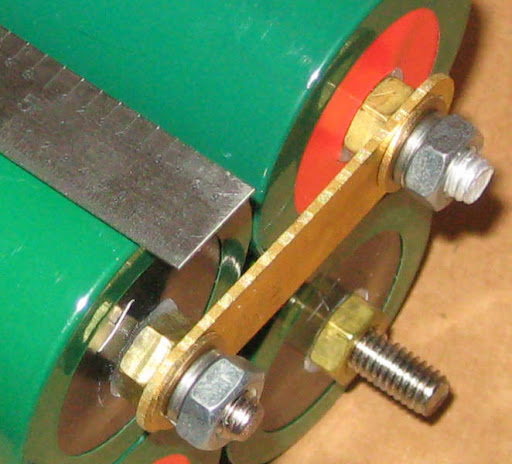
We have a couple of updates for you. The first is a 'demonstration' of why torque matters when attaching hardware to 40138 terminals. The second is one way to connect cells into a road-ready battery.

As the manufacturer of all 40138 cells currently on the market, Phoenix Silicon International (PSI) 'gets' to tell us how best to use our cells. One point they make clear is that it's not good to overtighten the nuts when wiring cells. Yes - here comes the 'why not?' part!

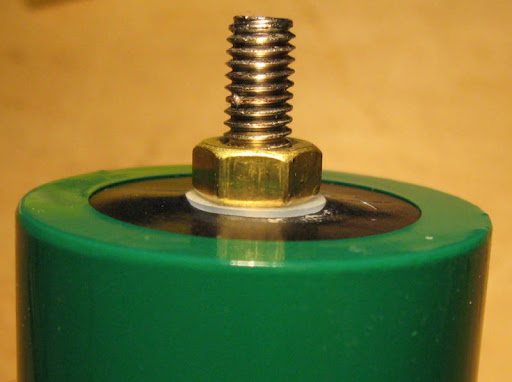
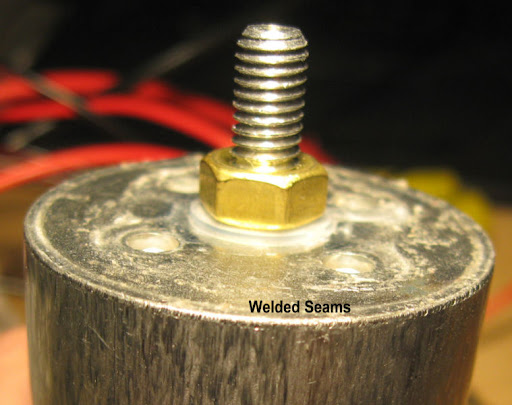
The terminal studs are made of different metals. The negative pole is plated copper. The positive - and the subject of our demonstration - is aluminum. And it's hollow. And it's threaded inside and out.

PSI gives us a torque limit of 6.9 in/lb or .78 nm and highly recommends using a torque driver or small torque wrench when installing hardware.


There are a number of decent (and better than decent!) torque drivers on the market and one can spend $157 and more - like this from SK. We found a fully functional yet frugal torque driver at Harbor Freight (online item 65397) for $34.99.


It's easy to set, 7 in/lb is far enough off the bottom of the scale to be reasonably accurate, and it just plain works. The driver accepts standard hex screwdriver bits, so you'll either need a specialty 10mm nutdriver bit or an adaptor for your 1/4 inch drive socket. Either way, it's cheap, easy, quick, brainless, and won't destroy the cells.

Ok - so you want to do more than string a bunch of cells together and make your living room lamp glow. Now what? Remember from an earlier post that the plastic seals on the cells are not designed to be pothole, expansion joint, or rock-hopping proof. A leaking cell is not a happy cell. We need a way to hold the cell bodies securely in the battery case so that the cells aren't hanging by the wiring - then we can hit the road.

PSI has one solution - the molded plastic assembly block.


Fit and finish of these is excellent! The mold part lines are accurate and there's no flash. The blocks have 'T' shaped locking tabs on two sides and can be assembled into many shapes. They don't have permanent locks - they're a friction fit - so the pack can be reconfigured easily.


Here's a pretty boring 12S pack. The block has .6 inch deep extensions cable-side to protect the wiring from the sides of the battery box. The extensions have pre-molded locations for fastening the pack into a hard box.

The blocks fit tightly enough that one can handle the pack, twist it around, and suspend it by one block and everything stays locked together.

One feature designed into the blocks is the gap between cells. This allows the center cells in larger packs to get cooling air. This isn't an issue for these cells until you start pulling 60+ amps from a cell, but it's one less thing to have to worry about when filling a box for a plug-in hybrid or pure EV.

For more information or to order assembly blocks or connecting straps, visit us at www.rechargeablelithiumpower.com

Monday, November 3, 2008

Lithium VS Lead

Is a picture worth a thousand words?

In this corner, weighing in at 24 lbs, is a 36V 12Ah pack of AGM lead acid. And in this corner, weighing in at 10 lbs, is a 36V 10Ah pack of LiFePO4.


The LiFePO4 pack consists of 12 40138 cells in series. The lead acid pack is three Werker 12V 12Ah batteries from Batteries Plus. In each pack, cells were fully charged and balanced. They were both discharged thru a 10A load until reaching the pack cut-off of 30V for the lead and 29V for the LiFePO4. Ambient temperature was 21°C.


The lead acid pack started just above 36V but voltage started to drop early on and kept falling until hitting a 'shoulder' at around 6.6Ah. The LiFePO4 pack started above 36V and stayed until 8.4Ah.

Voltage Support: Advantage Lithium.

The 12Ah lead pack provided just under 7Ah (58% of rated capacity), while the 10Ah LiFePO4 pack provided just over 9.6Ah (96% of rated capacity).

Power output: Advantage Lithium.

Discharge cycles: Lead acid should give somewhere between 300 and 500 cycles at 100% depth of discharge. Our LiFePO4 should give about 1500 cycles at 100% depth of discharge.

Discharge cycles: Advantage Lithium

Weight: 10lbs VS 24lbs Advantage Lithium

Overall value: Lead was $44.95 each for a total of $134.85. If we get 400 cycles of 6.93Ah, we're paying $.0486 per Ah. (A more realistic 300 cycles costs us $.0649 per Ah.) LiFePO4 at $48 each was $576. If we get 1500 cycles of 9.63Ah, we're paying $.0399 per Ah.

Overall value: Advantage Lithium

Smaller, lighter, more power for a longer period, no hazardous chemicals - what's not to like?!

Saturday, November 1, 2008

LiFePO4 Battery Pack Management - Part 1

Welcome Back!

You just know that any day that starts with a good cup of coffee and new toys to play with is heading in the right direction! We’ve had a couple of these days in a row – here’s how they’ve unfolded so far:

The first part of the fun began when UPS brought the battery management board kit that we ordered from Gary Goodrum at TPPacks.com. He and others on the Endless Sphere battery forum designed a battery management board tailored to PSI and A123 LiFePO4 cells used in electric bicycle-sized battery packs.

It took a couple of minutes to remember which box the soldering irons were in, then the fun started. The BMS went together quickly and worked first time. Always a good sign!


The next piece of the puzzle happened along last week when our friends at UPS brought us a couple of boxes. Now we have a new batch of 40138 cells to use – and some new battery chargers to test.


Stay tuned for part two - the fun is just getting started!

Thursday, October 2, 2008

Energy Plans and Our Future

Welcome to October!

The tests continue on our guinea pig cells. We've completed 50 discharge cycles on 'old silver'. It's in the middle of a slow discharge test with periodic internal resistance samples - 30 minutes down, 4 1/2 hours to go. We'll post internal resistance results for our most experienced cell once we've worked thru the numbers.

We've also gotten requests for a look at the equipment we're using to perform these tests. Thank you for the requests - your reviews are on their way!

We'd like to depart from tech for a couple of minutes and talk about one of the reasons we're interested in LiFePO4 cells and their support. Thanks for your indulgence as we editorialize a bit.

We've just finished watching a couple of clips from C-SPAN. The latest is a short discussion of the connectedness of energy, food, and water in both the global and US economy. Here's a link to the main C-SPAN energy page. Scroll down to the 'Recent Programs' area and look for the "Clinton Global Initiative Conference" from September 25th. This talk, moderated by Tom Brokaw, was a conversation with Bob Zoellick, President of the World Bank, Shimon Peres, President of Israel, T. Boone Pickens, Chairman & CEO of BP Capital Management, Helle Thorning-Schmidt, leader of the Danish Social Democratic Party, and Gavin Newsom, Mayor of San Francisco.

One point we came away from was the reminder that it's very difficult or impossible in a complex and interconnected system to solve only one problem at a time. It's sort of like medical triage in a way. Basic first aid reminds us to scan the area for immediate threats first, then move quickly to check airway, breathing, and circulation. We can get to broken bones a bit later.

If an accident victim is found unconscious, not breathing, and bleeding from an artery, we have to work on controlling the bleeding and do something about getting oxygen into the system in short order. Focus on either problem while ignoring the other virtually ensures 'mission failure'.

Put another way - if you find yourself in a hole, the first step is to stop digging.

As we prepare this, our representatives in Washington DC are working on the "Emergency Economic Stabilization Act of 2008". One of the numbers we hear is that it will cost the US Government at least 700 billion dollars to stabilize things and restore confidence in the economy, credit system and stock market.

$700 billion is an interesting number and one we've heard before - from Texas oilman Boone Pickens. He reminds us in his advertisements and on the Pickens Plan website that we're spending around $700 billion each year for foreign oil. This money leaves the country and doesn't provide jobs or tax income.

We must have an energy plan in this country that helps us transition to renewable energy and helps us wean ourselves - the quicker the better - from petroleum imports. We think groups such as Pickens' and the WE campaign are helping bring energy awareness into the US presidential campaign. We think it's all connected - energy, food supply, water, the economy, jobs, climate change, transportation - and that the ability to solve these challenges is ours. We've proven in our past that with a plan and desire we can climb great heights.

There's discussion by some that we need a "Manhattan Project" of sorts for energy and the economy. Tom Brokaw referenced the '100,000 garages' concept attributed to author Tom Friedman while talking with Mayor Newsom in the interview referenced in paragraph four. I found that the reference is from Friedman's book Hot, Flat, and Crowded. Here's a quote from WIRED magazine:

"Twelve guys and gals going off to Los Alamos won't solve this problem...We need 100,000 people in 100,000 garages trying 100,000 things — in the hope that five of them break through."
So...here we are, typing and listening to the battery analyzer's cooling fan cycle on and off as our test cell is poked and prodded. Which of you, of the interconnected 'us', will be one of Friedman's five to find solutions? What part, if any, will LiFePO4 play in our renewable future?

Enough of this for now - back in the garage!

Tuesday, September 16, 2008

LiFePO4 40138 Cell - Close Up

I admit it. I have to take things apart. A device sitting there hermetically sealed in shrinkwrap seems normal at first. At some point, however, a small voice starts to taunt from somewhere inside that shrinkwrap. And that's it. Out comes the tools.

Here's a closer look at a single 40138 cell. This construction seems to be fairly typical of other 40138 cells.

Before: Cell with insulating end label and shrink wrap in place. The cell ends are covered with an adhesive label. There's an 'X' cut into each label that falls over the cell vent. There's a vent in each end of the cell. The rest of the cell is covered in a layer of shrink wrap plastic.

After: The complete cell in all its bare aluminum glory. The body of the cell (tubing and end caps) is aluminum.
Close-up of cell end showing thick cast end cap with gas vent and four depressions. Each end has a vent and four circular depressions. The depressions appear to be features of the end caps, which appear to be cast. The depressions are 1.47mm deep and the vent is 1.59mm deep.

End caps are welded to the cell body tube. The joints between the body tubing and end caps are welded.


I don't mind working with a bare cell on the bench, but it's important to ensure the cell covering remains intact in use. The cell can be shorted between positive and negative terminals like any other cell, but it can also be shorted between either terminal and the outer cell casing (aluminum body tube and end caps).

For example - this cell is fresh from the charger and is reading 3.557 volts between the positive and negative terminals. There is 1.074V between the positive terminal and the case, and 2.482V between the negative terminal and the case.

Whether you're making an electric bicycle pack or a battery for your electric trolling motor, mount the cells securely and isolate them from each other and any part of the battery pack that will conduct electricity. It won't take very many miles of e-biking to wear thru the shrink wrap.

Saturday, September 6, 2008

Working with 40138 Cells

40138, A123Systems 18650 and 26650 LiFePO4 Cells Here's a 'family portrait' of sorts. The pair of yellow cells are A123Systems 18650 cells. These were removed from a Black and Decker VPX pack. The larger white cell is a 26650 cell from A123Systems. It was removed from a 36volt DeWalt DC9360 battery pack. The green cell is our text subject, a 40138 LiFePO4 cell.

The numbers - 18650, 26650 and 40138 - give cell dimensions in milimetres. The first pair of numbers - 18, 26, and 40 are the cell diameter. The 650 and 138 are cell length without terminals...almost. The smaller cells swap the zero around. The pair of cells from A123Systems are about 65mm long - not 650.

The smaller cells have connections spot welded on. The larger cell is fitted with 6mm bolts. This makes it easy to wire a pack, and change pack configuration later.

Closeup of 40138 negative terminal showing nut and sealing washer

Here's a close-up of a cell terminal. See the nylon washer under the nut? That's part of the cell's sealing system. The nuts on the terminal studs must stay in place. Loosen the nut and the cell will leak.

The cell is covered with a layer of shrink wrap insulation. There's a barcode label on the aluminum cell casing in addition to the one on the outside.

Cell connection example - connecting strap with nut and lockwasherHere's a terminal mounting example. The connection strap is against the nut installed on the cell. There's an optional flat washer against the strap, then a mandatory lock washer, and nut.

Connecting example using 1/4 inch ring terminals

Here's another wiring example. The 1/4 inch crimp-on ring terminals are connected to 10AWG wires. There's enough room for a pair of terminals as long as they're 'back to back'.

It's very important to secure each connection. Use lock washers, spring washers, locktite, or something similar on all cell connections. Electrical resistance increases when a connection becomes loose. Just like an electric stove burner, current flow and resistance equals heat. At best, performance will decrease as nuts loosen. At worst, the connection can heat enough at higher electrical flow to start a fire.

Inspect cell connections as part of your preventive maintenance schedule. You can use fingernail polish on the end of the nut to see if the connection has loosened.

It's best to use a torque wrench when assembling cells into a pack. Maximum torque is 6.9 lb-in or .78 nm.

Monday, August 25, 2008

The Boss Escapes!

More fun! We continued discharges in 5A increments are got up through 7C with a constant 70A discharge. The test cell gave up 9.4Ah in a hair over eight minutes before reaching the 2.1V cutoff. Cell temperature peaked at 52.6ºC (126.7ºF).

Here's a recap of 55A thru 70A:

55A thru 70A / 5.5 to 7C


While we were talking about the way the capacity slowly creeps downward with each increase in load, we heard familiar whining noises from the bosses office. We decided we had to get to a 10C discharge so we could stop delivering food to his office three times a day. Besides - he needs a shower...

The cell isn't rated for a continuous 10C discharge so we took advantage of the option on the 10X CBA amplifier to cycle amplifier power during a test. We cycled power/load in roughly 15 second intervals. First two 'spikes' are 15 seconds load, 15 seconds 'rest'. Then we walked it out to 30 seconds on, 15 off; then 45 seconds on and 30 seconds off. The test ran for nine minutes 50 seconds and the CBA reported a cell capacity of 16.4Ah.

100A / 10C pulse discharge

Now..about the bosses office - Febreze or Lysol? Both!